Local HMI Systems
Independent local control and monitoring at unit level with redundant operational capability
HMI systems are often associated with SCADA platforms, as they share similar functionalities and are frequently developed within the same environment.
However, their distinct difference is in the underlining application objectives of each.
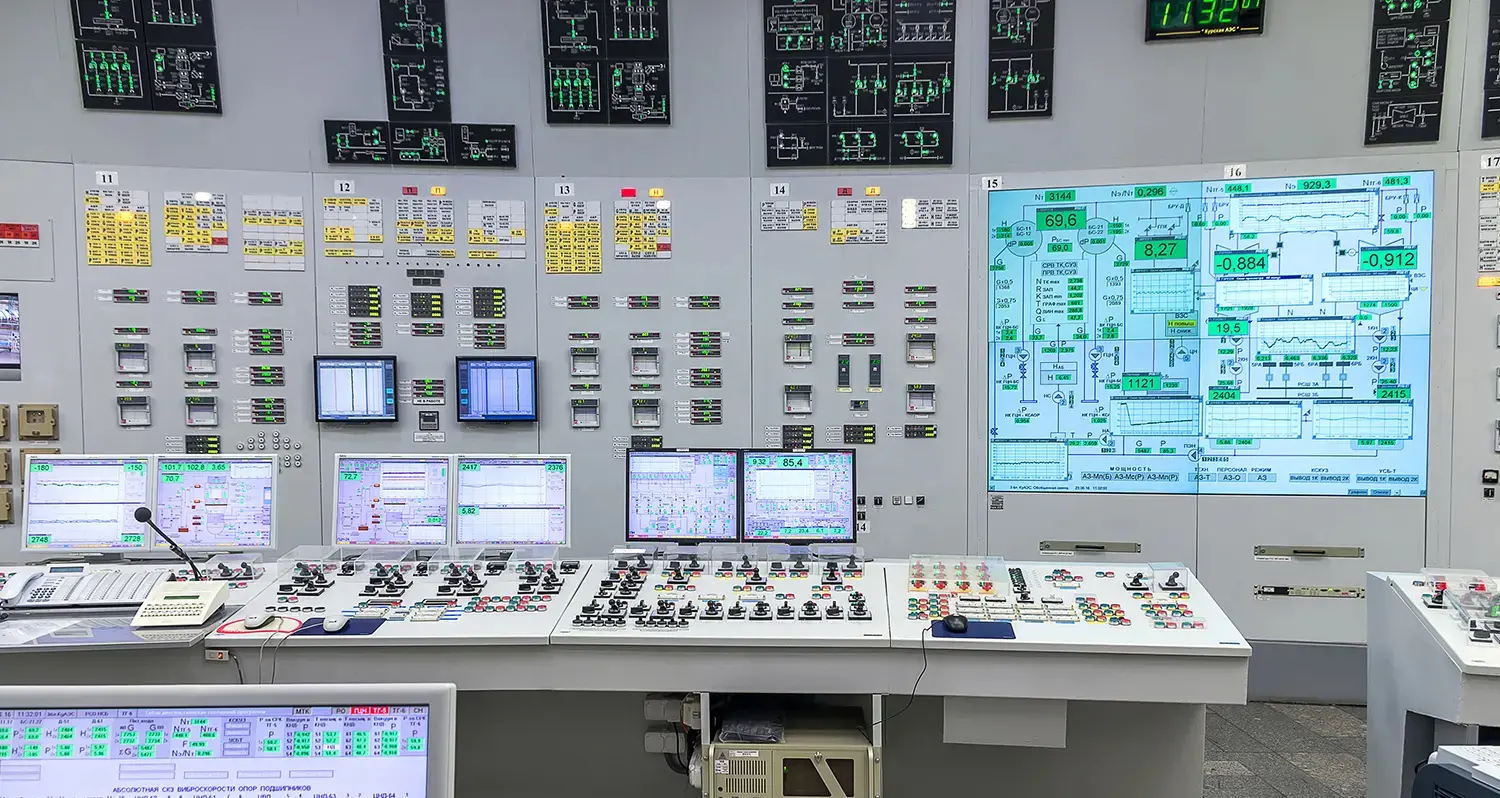
HMI systems are typically found in Local Unit control panels and sometimes, in the local unit control room (often in the absence of plant SCADA system). HMI systems are designed and implemented and optimised to provide information and control capabilities at unit level.
MAS has prolonged experience in HMI systems across a wide range of installations.
Our approach goes beyond interface design, focusing on system architecture, reliability and operational integrity.
To ensure availability and backup controls, MAS designs its HMI systems as fully separate and autonomous layers, distinct from both SCADA platforms and physical control interfaces. This architecture provides:
- Independent supervisory and control capability at unit level
- Redundancy and backup operation in case of higher-level system failure
- Reliable local access for operators under all operating conditions
As such, MAS’ HMI systems provide a parallel supervisory and control platform to the local operators to work on, safeguarding safe and efficient operation of critical assets.
Installation SCADA Systems
Centralised monitoring and control of single installations with real-time data acquisition and coordination
Although IT solutions are widely available as upper-level systems that gather data and provide additional analytics, SCADA remains the core OT infrastructure of primary interfaces with physical assets.
MAS SCADA systems are well designed, considering several factors including:
- The primary signals to collect and the secondary information to be derived / calculated in real-time.
- Local and WAN Topology
- Real time data propagation and historical data synchronization.
- Availability factors / local redundancy / network redundancy & pear redundancy
- Access Security & Cyber security
- Data interfaces with third systems & data to share
MAS structures SCADA solutions according to their scale. At the Plant level, SCADA systems provide unified operational control of a single installation, such as power plant or industrial unit.
They usually include:
- Local control room systems,
- Central control room systems.
- Office information systems.
Handling thousands of I/O points, Plant SCADA systems are built on central servers and peripheral workstations to ensure coordinated plant/unit operation.
Portfolio SCADA Systems
Centralised visibility and management of geographically distributed assets across all assets portfolios and fleets
Wide Area Portfolio and Fleet SCADA systems are designed by MAS to provide centralised monitoring and management of geographically distributed assets, including:
- multiple plants
- remote stations / assets
- vessel fleets
These systems handle large data volumes – often hundreds of thousands of information per second- and are designed to aggregate live and historical data across multiple locations and users.
Their topology and design differ, depending on the available communication mediums.
MAS Wide-area Portfolio / Fleet SCADA Systems deliver:
- Consolidated live and historical data across multiple locations
- Centralised operational visibility and coordination
- Multi-user access across different sites and organisational levels
- Advanced analytics and performance evaluation capabilities.
- Valid, reliable Up-to-date information to feed upper-level operations
MAS’ portfolio includes wide-area and power station SCADA deployments across multiple islands, remote plants and complex energy environments, including supervision and control systems for non-interconnected island systems and unmanned hydro applications.
Vessel Performance Monitoring
MAS VESSEL PERFORMANCE MONITORING PLATFORM
Integrated monitoring and optimisation of vessel systems for performance, reliability, efficiency and compliance.
The increasing complexity of modern vessel operations, combined with regulatory requirements for fuel consumption and emissions, including IMO EEXI, CII and SEEMP, drives the need for advanced performance management systems.
MAS delivers end-to-end digital solutions for comprehensive vessel performance management, including fuel consumption and voyage optimisation and torque metering.
The solution is fully customised to each vessel’s configuration, installed systems, operational profile and reporting requirements.
MAS Vessel Performance Monitoring Platform meets strict performance, reliability and validation standards, making it fully suitable for all types of vessels and operational environments.
A unified environment: consolidated data from critical onboard systems, including:
- ECDIS / GPS and voyage data
- Flow metering systems
- Main and auxiliary engines
- Shaft-power metering & torque monitoring
- Security surveillance cameras / CCTV systems
- Ballast water systems
- Cargo handling systems (elevators, cargo pumps, cranes)
- Existing automation, alarm and control systems
Core capabilities include:
- Centralised real-time monitoring of connected systems
- Real-time condition monitoring
- Early fault detection and alarm management
- Fuel consumption and emissions monitoring
- Accurate shaft-power analytics for torque metering
- Operational performance analytics
- CII-related operational performance tracking
- EEXI and SEEMP-aligned data visibility
- Compliance metrics and reporting support
- Ship-to-shore data integration and reporting
- Fleet-level performance benchmarking
MAS Engineering Integration
Seamless interoperability with existing infrastructure
MAS integrates the Vessel Performance Monitoring Platform within the broader vessel automation architecture, ensuring seamless interoperability with existing control systems, Power Management Systems, governors, automation platforms and onboard data acquisition infrastructure.
Custom solution for each vessel
The solution is not delivered as a standard off-the-shelf software layer. It is tailored to each vessel’s onboard systems, available data sources, communication architecture, operational objectives and fleet reporting needs.
Flexible software & hardware interfacing
The platform operates on validated data provided by MAS Marine Data Acquisition Platform or by existing onboard data acquisition systems. Where required, it can also be directly interfaced with propulsion control systems to support real-time optimisation of vessel operation.
Customer value for shipowners & vessel operators:
By consolidating and analysing system-wide data, the platform enables enhanced operational visibility, improved situational awareness, early fault detection, predictive maintenance, reduced unplanned downtime and improved vessel performance
- Energy management and performance optimisation
Transformation of raw data into actionable insights, supporting crew and onshore teams in optimising vessel performance
- Fuel consumption optimisation
Advanced algorithms correlate operational parameters with fuel usage, enabling measurable efficiency improvements
- Voyage and routing optimisation based on real operating conditions
Data-driven evaluation of voyage, routing alternatives, speed and operating profiles to support more efficient vessel operation
- Power profile optimisation
Data-driven optimisation of speed, load distribution and power usage based on real operating conditions.
- CII, EEXI and SEEMP compliance & charter reporting support
Transparent and validated vessel data, compliance metrics and reporting support
- Fleet-wide performance benchmarking
Standardised data structures enable performance comparison across vessels and identification of optimisation opportunities at fleet level.
- Fully customised deployment according to vessel and fleet needs
The platform is flexible, scalable and adaptable, capable of adjusting to each vessel specific current and future needs and objectives.
- No recurring annual platform licence fees
MAS’ collaboration philosophy with its customers is based on respect, long-term partnership and customer ownership of the investment . We provide high-quality solutions, services, support and training empowering our customers to operate and benefit from their digital infrastructure with confidence.
Talk to our software engineering team to discuss digital vessel performance solutions tailored to your fleet’s needs.
Data Acquisition Platform
Structured real-time data acquisition and validation across all onboard systems for reporting and optimisation
Reliable fleet management and compliance with IMO reporting requirements depend on the availability of valid, accurate, consistent and real-time operational data across all vessel systems.
MAS has developed a purpose-built marine Data Acquisition Platform designed for the installation on any type of vessel and capable of interfacing with all available equipment, such as:
- Main and auxiliary engines
- Fuel levels and fuel meters
- GPS systems
- Multiple Alarms systems,
- Any and other connected on-board systems
The system continuously:
- Collects and stores in real-time data
- Processes and performs all needed statistical data analysis and aggregations
- Establishes validated data for fuel transparency, operational optimisation and regulatory alignment
- Supports performance evaluation and reporting requirements to third-party fleet management and reporting systems.
Data Acquisition Platform’s Engineering Architecture
MAS Data Acquisition Platform is engineered as a plug-and-play solution, consists of an industrial grade PC that ensures the needed robustness as well as the capacity to easily upgrade and extend its capabilities.
Depending on the installation, multiple data loggers can be installed within one vessel to make wiring and general installation as easy as possible.
Its modular and scalable architecture allows:
- Easy system expansion and functional upgrades
- Flexible integration with both legacy and modern onboard systems
- Distributed installation across multiple units within a vessel, optimising wiring, reducing installation complexity and improving system resilience
This approach aligns with MAS’ broader engineering philosophy of integrating data acquisition as part of a unified control and digitalisation architecture, enabling enhanced operational visibility and long-term asset performance optimisation.
MAS Data Acquisition Platform provides added value to shipowners:
- Access vessels remotely with real time visibility and monitor all connected subsystems
- Retrieve historical & statistical data for fuel transparency, operational optimisation and regulatory alignment.
- Provide reliable data to third party management and reporting systems
- Establish a validated data foundation for regulatory alignment and operational transparency
Propulsion Optimisation Platform
Real-time optimisation of propulsion and power distribution through integrated control and data analytics
MAS delivers next-generation digital propulsion optimisation solutions that support:
- Real-time propulsion performance management
Continuous acquisition and analysis of propulsion system data, including engines, shaft lines and auxiliary systems.
- Advanced analytics and data-driven operational decision-making at vessel level.
MAS propulsion platforms operate as the execution layer of vessel optimisation, translating data and analytics into real-time control actions.
Propulsion Control Platform Engineering
Unlike standalone digital tools, MAS ensures that solutions are fully embedded within the vessel’s control and automation architecture, enabling:
- Seamless integration with existing control systems (governors, PMS, automation platforms)
- Reliable and structured data acquisition from source systems
- Unified data environment across propulsion, power and auxiliary systems
- Secure data handling and communication with shore-based platforms
This engineering-driven integration approach ensures that digitalisation is not treated as an add-on, but as a core operational capability.
MAS digital solution enables shipowners and operators to:
- Improve fuel efficiency and reduce operational costs
- Enhance vessel performance and operational consistency
- Support regulatory compliance (CII, emissions monitoring, reporting)
- Enable data-driven decision making (onboard & onshore)
- Transition from reactive to performance-optimised operations
Cybersecurity
Secure system architectures ensuring protected data flows, controlled access and resilient operation
MAS addresses cybersecurity as an integral part of system engineering, ensuring that control, automation and digitalisation solutions are designed, implemented and operated within a secure and compliant framework.
MAS operates under ISO 27001 Information Security Management certification, ensuring structured governance, secure data handling and controlled access to critical systems.
Engineering Approach to Cybersecurity
MAS integrates security principles directly into system architecture and lifecycle engineering:
- Correct infrastructure by selecting equipment that comply and can provide needed safety requirements
- Secure System Architecture Design
Segmentation of control networks (OT) from IT systems, controlled interfaces and secure communication channels
- Access Control & User Management
Role-based access, authentication policies and controlled system privileges
- Secure Data Acquisition & Transmission
Protected & encrypted data flows between field devices, control systems and remote monitoring platforms
- System Hardening & Configuration Control
Structured configuration management, version control and secure update deployment practices
- Traceability & Event Logging
Full logging of system events, alarms and operator actions, supporting auditability and incident analysis
- Lifecycle Security Management
Secure engineering practices from design and commissioning to maintenance and remote support
This approach ensures that cybersecurity is embedded within the operational logic of the system, not added as an external layer.
 Explore MAS SCADA & Digitalisation Integration Systems